
A customer with a multi-zone automated conveyor line wanted to know two things:
- If their control code was contributing to jams and lost performance
- If the code could be checked and tested before any further new hardware was installed
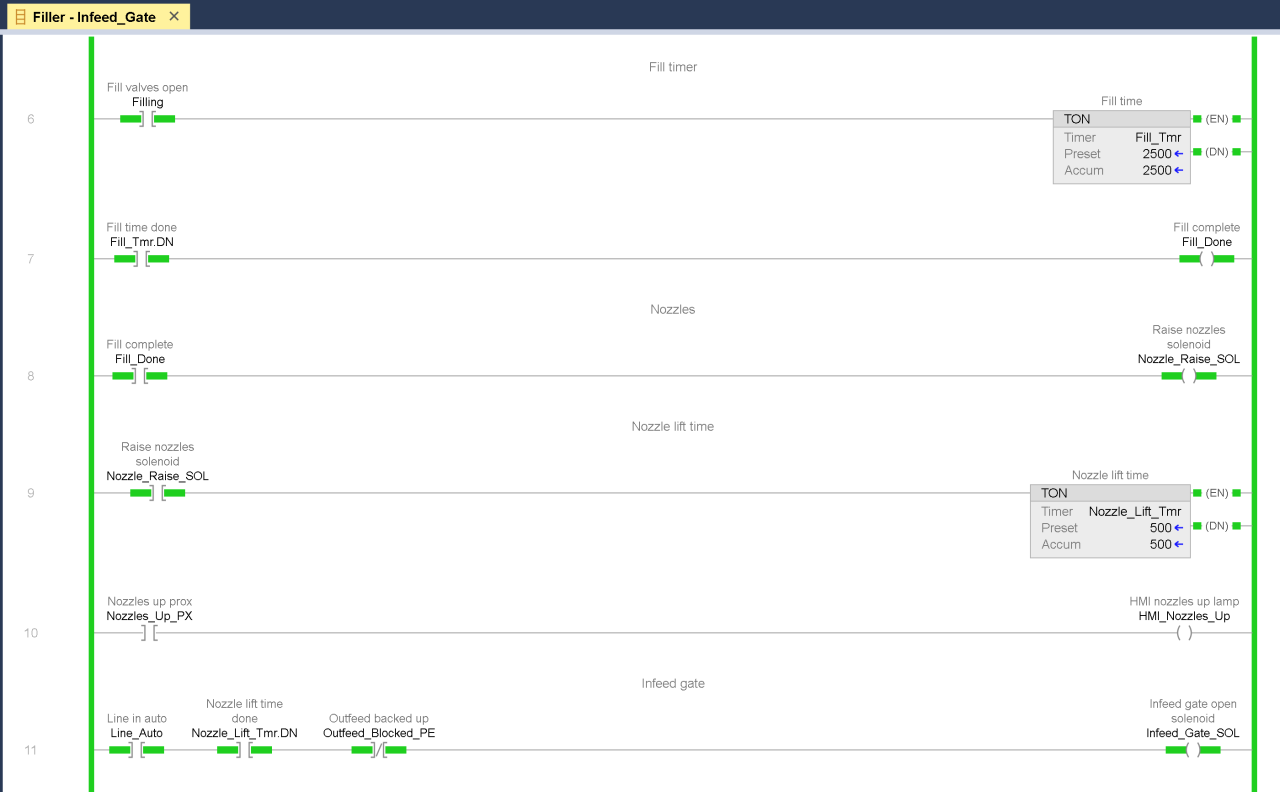
Autologic answered both by running the customer’s live PLC program against an Emulate3D simulation model of the line.
Summary
|
Facility |
Multi-zone automated conveyor line with lift transfers, stackers and inspection stations |
|
Approach |
Emulate3D emulation driven by an offline copy of the customer’s real PLC program |
|
Focus |
Virtual commissioning, control logic diagnosis and performance improvement |
|
Outcome |
Recurring jams eliminated in the model, a model-crashing fault traced and fixed, and latent code defects identified |
The project
The project ran in two stages, building on earlier simulation work carried out by AutoLogic.
Stage 1: emulating the line with the customers control code
- Built an Emulate3D model of the line from the customer’s design and electrical drawings.
- Connected it to an offline copy of the customer’s PLC program (but based on the network used on site).
- Bound and tested several hundred IO (Input/Output) points, including safety signals, and cross-checked sensor coverage against the IO schedule.
Stage 2: analysing the control logic
- Ran the line under representative load, with realistic physics so that loads twist, drag and jam as they would on the real equipment.
- Traced each unexpected behaviour back to the specific logic responsible.
- Trialled targeted changes, reran the model and measured the effect of each one.
- Reviewed the wider program for latent defects that no acceptance test would reveal.
The results
Our simulation and analysis detecte 2 key issues.
The first were operational faults visible in the model:
- Loads dragged sideways into lift transfers because a conveyor restarted before the transfer had finished unloading, leaving loads twisted and jammed.
- A mistyped speed value that sent a drive an out-of-range command and crashed the model as soon as a transfer operated.
The second were secondary defects in the code itself:
- A recovery routine that was written but never called.
- Conflicting rungs setting the same sensor signals to different values.
- Protective signals bypassed in places.
- Always-false instructions blocking manual and auto access and motor feedback.
- Duplicated code copied between zones without being edited.
- Sensor positions that had to be precise for the logic to work reliably with both load sizes.
Applying the findings
- At the two transfer points where jams were reproduced, changes to the conveyor hold logic and a shorter stop timer removed the jams in the model.
- At one junction, the jam rate for one of the two load sizes fell from 4.9% to 0%.
- The model-crashing fault, which occurred after one or two loads, no longer occurred once the value was corrected.
All changes have been validated in the model and the customer is now applying their own change process ahead of any further deployment.
Benefits to the Customer
-
Root causes identified in the control logic rather than only the visible symptoms.
-
Fixes proven against a virtual copy of the line, with no risk to live production and no planned downtime.
-
Latent code defects found and documented before they cause a failure.
-
Evidence the customer’s controls team and integrator can act on directly.
-
A reusable model for testing future changes safely.
-
A route to checking control software before hardware is installed on the planned new line.